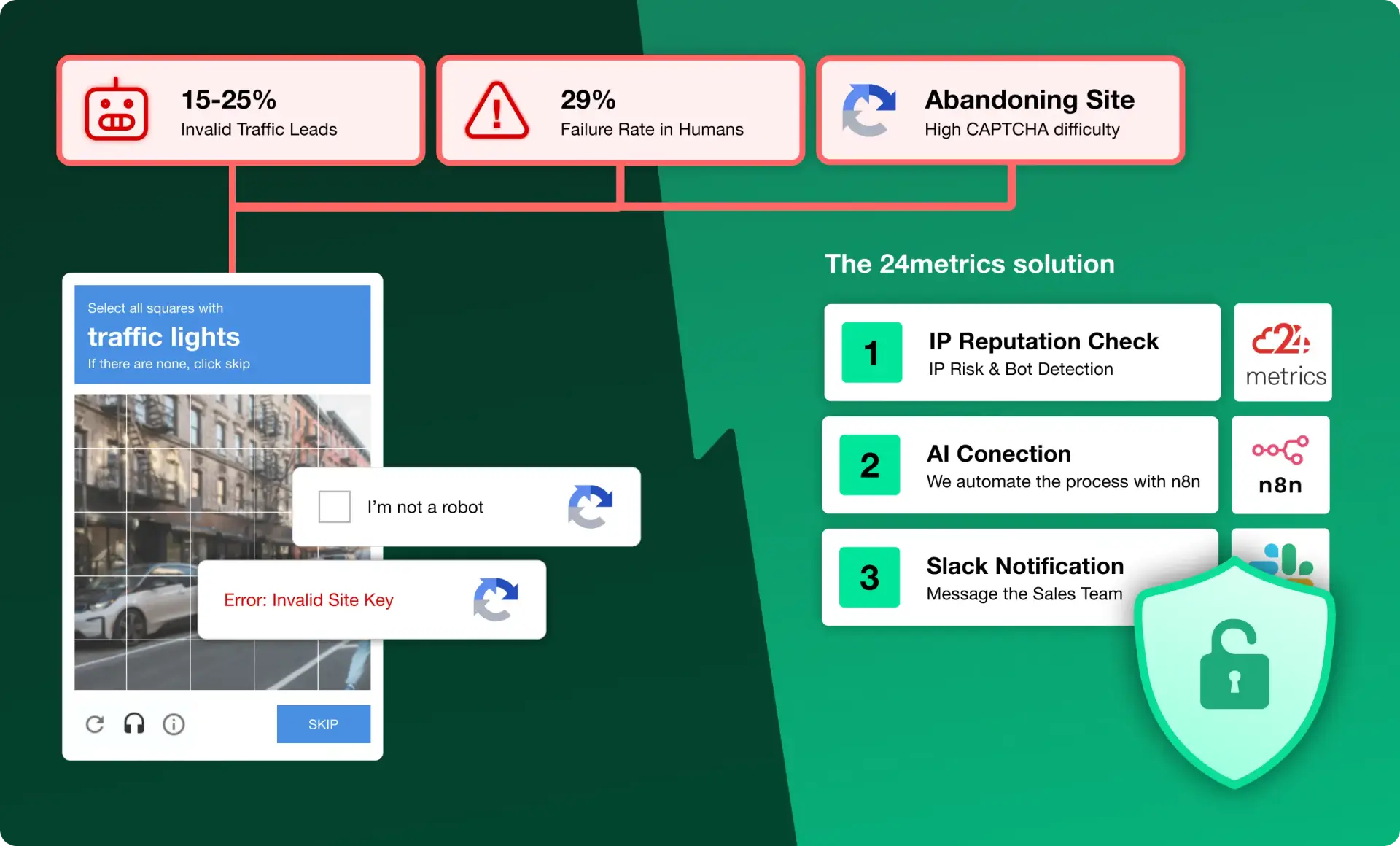

Your contact form should be generating sales opportunities, not headaches. Instead, you’re sorting through submissions from bots, spam messages promoting unrelated services, and fake inquiries that waste your team’s time. You’ve considered adding a CAPTCHA, but you’ve also experienced the frustration of failing those image puzzles yourself. There has to be a better way. The problem is real and growing. Studies show that 15 to 25 percent of all leads generated online are invalid or fraudulent.
At the same time, bot traffic has surpassed human traffic on the web for the first time in history. This creates a difficult choice for marketers: add friction that drives away legitimate prospects, or keep your forms open and deal with the noise.The good news? You don’t have to choose. There’s a smarter approach that combines IP intelligence with AI screening to stop fake leads before they reach your inbox, without making real visitors jump through hoops.
Why CAPTCHAs Are No Longer the Answer
CAPTCHAs were designed to separate humans from bots, but the landscape has shifted dramatically. Modern AI can now solve many CAPTCHA challenges with near-perfect accuracy, while human users struggle with an 8 percent failure rate on their first attempt. When case sensitivity is involved, that failure rate jumps to 29 percent.
The business impact is significant. Research from Baymard Institute found that users who fail two CAPTCHAs in a row are very likely to abandon the site entirely. Even being presented with a CAPTCHA is enough to make 1.47 percent of people abandon a form outright, even when they have strong motivation to complete it. One study showed that sign-up forms with CAPTCHAs converted at only 48 percent, compared to 64 percent for forms without them.
From personal experience, I’ve abandoned sign-ups when CAPTCHAs became unreadable after the third attempt. Your potential customers are doing the same thing right now. The irony is clear: CAPTCHAs have become easy for bots and frustrating for humans. We needed a different solution.
Building an Intelligent Lead Screener
We recently faced this exact problem on our own website. Our contact form, built with Contact Form 7 on WordPress, started receiving messages completely unrelated to our fraud prevention services. Generic sales pitches, bot-generated content, and inquiries from locations where we have no business presence.
Rather than adding friction for legitimate visitors, we built an intelligent screening system that evaluates each submission invisibly. Here’s how it works.
Step 1: IP Intelligence at the Point of Entry
Every form submission includes an IP address, and that IP tells a story. Our IP reputation system immediately analyzes whether the visitor is connecting from a residential connection, a data center, a VPN, or a known proxy service.
This first check catches a significant portion of automated spam. Bots typically operate from cloud servers and data centers, not from residential internet connections. When someone submits a contact form through a data center IP, that’s already a strong signal that something is off.
We also check geographic data, timezone consistency, and whether the IP has been associated with previous fraudulent activity. This creates a risk profile before we even look at the form content itself.
Step 2: AI Content Analysis
IP data alone isn’t enough. Some spam comes from legitimate-looking connections, and some real prospects might use a VPN for privacy reasons. The second layer uses AI to analyze the actual form submission.
Using n8n, an AI workflow automation platform, we built a screening process that evaluates multiple factors:
- Domain validation: Does the company domain in the email address actually exist? Is it a real business or a disposable email service?
- Business relevance: Does the company type match our customer profile? We serve affiliate networks, lead generation companies, and eCommerce brands. A message from an unrelated industry gets flagged.
- Geographic fit: Is the inquiry coming from a region where we typically do business?
- Message coherence: Does the content make sense in the context of fraud prevention services, or is it generic spam that could be sent to any website?
We trained the AI with examples of legitimate customer inquiries and known spam patterns. The model learned what real interest looks like versus automated or irrelevant submissions.
Step 3: Smart Routing Instead of Blocking
Here’s where our approach differs from simple blocking. We wanted to avoid false positives at all costs. A legitimate prospect who happens to use a VPN shouldn’t be rejected.
Instead of blocking suspicious submissions, we route them through different notification channels. Clean leads trigger an immediate Slack message to our sales team with full context. Flagged submissions go to a separate review queue with the specific reasons for concern.
This way, nothing gets lost, but our team’s attention stays focused on the highest-quality opportunities.
The Technical Implementation
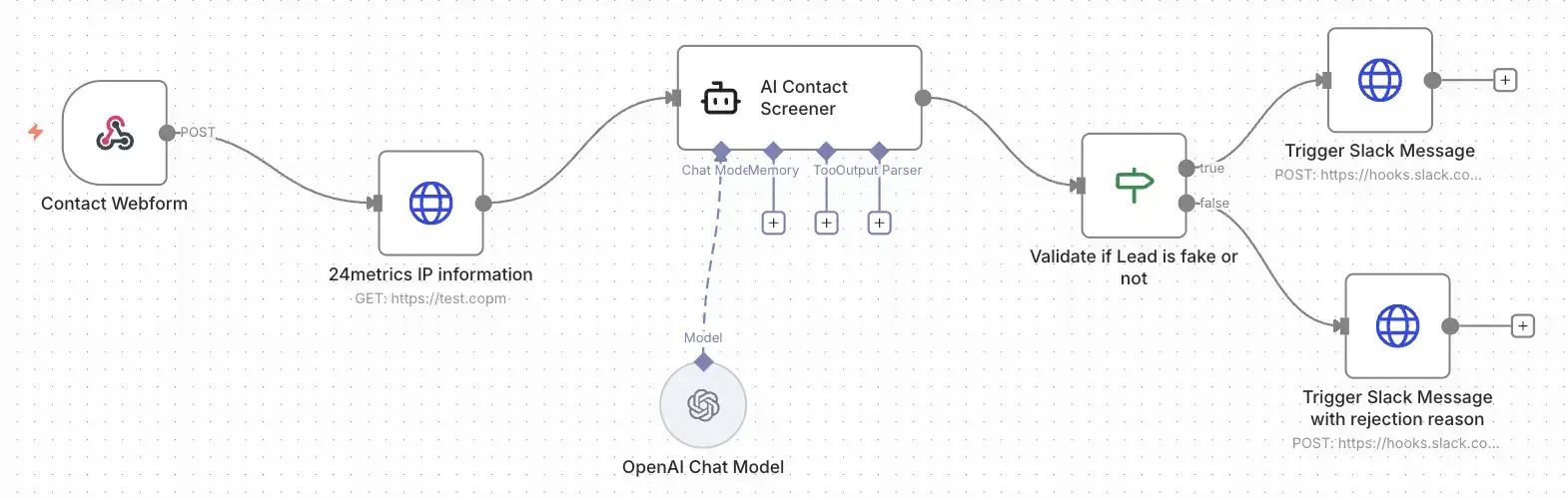 Our workflow connects several systems:
- Contact Form 7 captures the submission and passes data to our screening endpoint
- The 24metrics API provides IP intelligence including VPN detection, data center identification, and geographic data
- n8n orchestrates the AI evaluation using an OpenAI model configured with our business context
- Based on the combined score, Slack notifications are triggered through different channels
The entire evaluation happens in under two seconds. The visitor sees a normal thank-you message while our backend has already classified the submission.
For companies using our fraud prevention services, similar email validation and domain scanning capabilities are available through our API.
Results and Recommendations
Since implementing this system, our signal-to-noise ratio has improved dramatically. Spam still arrives occasionally, but it’s clearly marked and separated from legitimate inquiries. More importantly, we haven’t blocked a single real prospect.
If you’re dealing with form spam, here are the key principles:
- Layer your defenses. IP intelligence catches the obvious bots. AI catches the more sophisticated spam. Together, they’re far more effective than either alone.
- Prioritize false positive prevention. It’s better to review a few spam messages manually than to lose a genuine customer. Design your system to flag and route, not to block outright.
- Keep the user experience clean. Your visitors should never know the screening is happening. No CAPTCHAs, no verification emails, no friction.
For organizations processing high lead volumes, our enterprise solutions can integrate this type of screening directly into your lead capture workflow, whether you’re running affiliate programs, paid acquisition campaigns, or organic lead generation.
The days of choosing between form spam and user friction are over. Intelligent screening gives you both: clean leads and a seamless experience for the people who matter most.
Ready to stop fake leads from polluting your pipeline?
Try our free IP reputation check to see what intelligence is available for any IP address, or explore our plans to integrate fraud prevention into your lead generation workflow.