Affiliate Link and Redirect Checker
Identify broken links, too many redirect hops, high latency links and more with our Link Testing Tool
What is the Affiliate Link Testing Tool?
It helps testing redirects of affiliate links and visualizes their link redirect chains. Simulating different locations and devices helps you to verify if links are still active, redirecting to the correct page or are broken. It supports 301 / 302 redirects, smartlinks and shortened links.
Global & Device Validation
Simulate clicks from different geographic locations and mobile or desktop devices to verify your links are still active and targeting the right audience.
Landing Page Accuracy
Ensure every click is redirecting to the correct landing page rather than a broken 404 or a generic “offer expired” screen.
Comprehensive Protocol Support
Our system fully supports 301 and 302 redirects, as well as complex smartlinks and shortened links, giving you a transparent view of every “hop” in the journey.
Find Broken Links & Redirect Issues
You just launched a campaign. Traffic is flowing. Clicks are happening. But conversions? Flat.
The problem might not be your creative or your targeting. It could be something far more basic: your affiliate links are broken, redirecting to the wrong page, or failing to open on mobile devices.
Every day, performance marketers lose thousands of dollars because of link failures they never knew existed. A redirect chain that adds 3 seconds to load time. A geo targeting rule that sends German users to the US store. A deep link that dumps iOS users on a web page instead of the app.
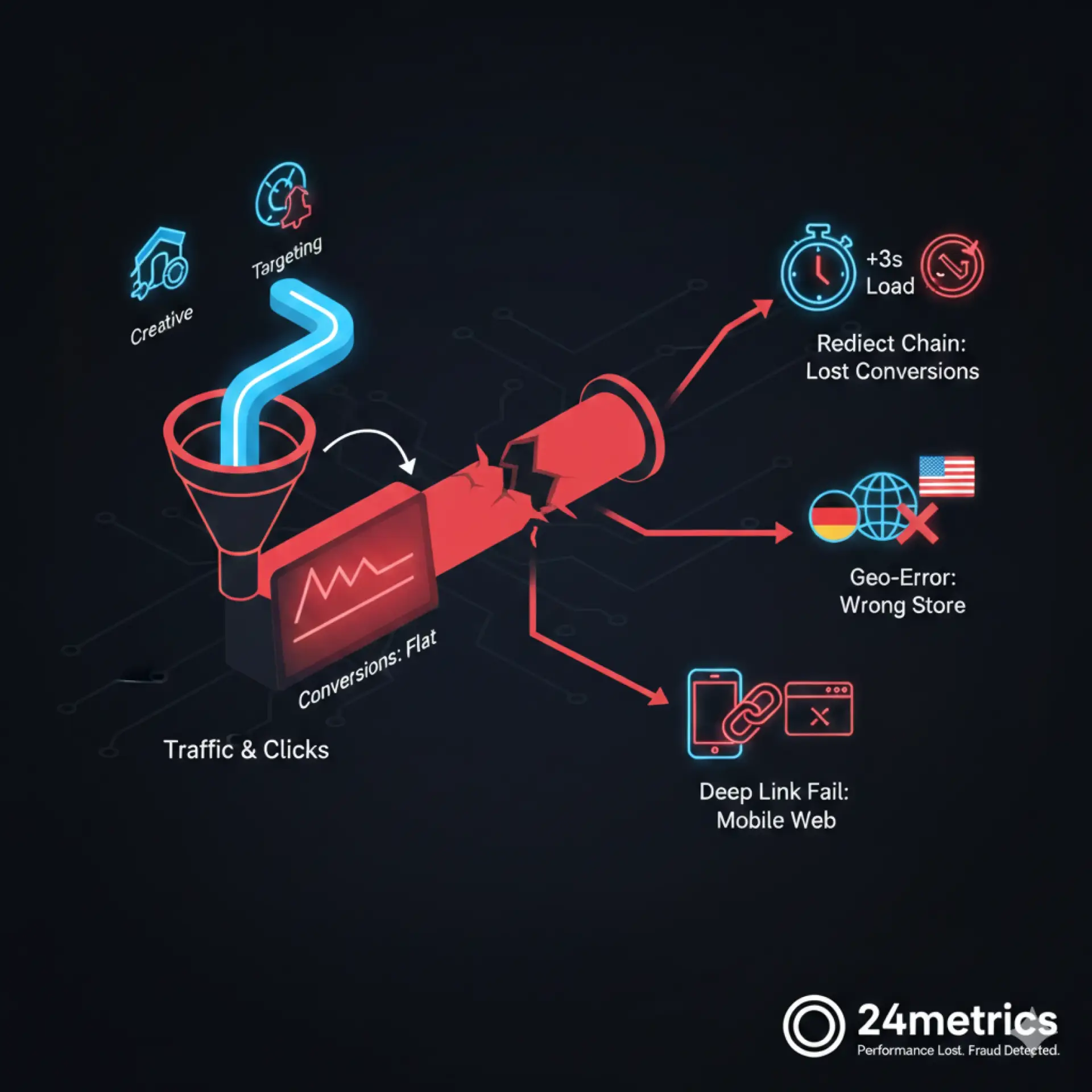
Find Broken Links & Redirect Issues
You just launched a campaign. Traffic is flowing. Clicks are happening. But conversions? Flat.
The problem might not be your creative or your targeting. It could be something far more basic: your affiliate links are broken, redirecting to the wrong page, or failing to open on mobile devices.
Every day, performance marketers lose thousands of dollars because of link failures they never knew existed. A redirect chain that adds 3 seconds to load time. A geo targeting rule that sends German users to the US store. A deep link that dumps iOS users on a web page instead of the app.
Why Traditional Affiliate Tracking Isn’t Enough
The affiliate marketing ecosystem has grown increasingly complex, with a single tracking link often passing through multiple redirect servers before reaching its final destination. Each hop introduces potential failure points.
When someone clicks an affiliate link, it first hits your tracking platform, then passes to the advertiser’s system, may route through a fraud detection layer, and finally lands on the destination page. If any step in this chain fails or is delayed, the conversion is at risk.
For networks and advertisers processing millions of clicks daily, even a 1% link failure rate can translate into significant revenue loss. That’s why leading performance marketing teams invest in systematic link validation as part of their fraud prevention and quality assurance workflows.

Why Traditional Affiliate Tracking Isn’t Enough
The affiliate marketing ecosystem has grown increasingly complex, with a single tracking link often passing through multiple redirect servers before reaching its final destination. Each hop introduces potential failure points.
When someone clicks an affiliate link, it first hits your tracking platform, then passes to the advertiser’s system, may route through a fraud detection layer, and finally lands on the destination page. If any step in this chain fails or is delayed, the conversion is at risk.
For networks and advertisers processing millions of clicks daily, even a 1% link failure rate can translate into significant revenue loss. That’s why leading performance marketing teams invest in systematic link validation as part of their fraud prevention and quality assurance workflows.
Common Affiliate Link Problems & How to Detect Them
Broken Links & Dead Destinations
The most obvious failure is a link that simply does not work. The destination page returns a 404 error, the domain has expired, or the product has been discontinued. These broken links create terrible user experiences and waste your advertising spend.
Detection requires actually requesting the final URL and verifying it returns a valid response. Our Link Check API performs this validation at scale, testing thousands of URLs per minute and flagging any that return error codes.
Excesive Redirect Chains
Every redirect in a chain adds latency. Research consistently shows that page load delays directly impact conversion rates. When your affiliate link passes through 5, 7, or even 10 redirects before reaching the landing page, you are bleeding conversions with every hop.
Worse, long redirect chains are a common indicator of rebrokering. This happens when unauthorized parties insert themselves into the redirect path to steal commissions. If you suddenly see your links routing through unfamiliar domains, that is a major red flag.
A proper affiliate link tester counts each redirect and maps the complete chain from initial click to final destination. This visibility lets you identify bloated paths and suspicious intermediaries.
GEO Testing Failures
Global campaigns require links that behave correctly for users in different countries. A link meant for UK traffic should land on the UK site, not default to the US version. Currency mismatches, language errors, and regional product availability issues all stem from geo targeting failures.
Testing geo behavior requires simulating clicks from different locations. Our platform uses residential IPs worldwide to test how links perform from the actual geographic perspective of your target audiences. This catches issues that would be invisible from a single testing location.
Platform Incompatibility
Mobile traffic now dominates affiliate marketing. But mobile introduces unique challenges around deep linking and app detection.
When a user clicks an affiliate link on their phone, what should happen? Ideally, if they have the advertiser’s app installed, the link opens directly in the app to the relevant product page. This is called deep linking, and it dramatically improves conversion rates compared to mobile web experiences.
But deep links break constantly. App updates change URL schemes. Platform policies evolve. What worked last month might dump users on an error page today.
Our affiliate link tester validates deep link behavior across iOS and Android, checking whether links correctly trigger app opens or gracefully fall back to mobile web when the app is not installed.
Wrong Domain Destinations
Sometimes links technically work but send users to the wrong place entirely. A link meant for a specific product page lands on the homepage. A link for Partner A’s offer somehow ends up on Partner B’s site.
These misdirections often indicate configuration errors in tracking platforms. They can also signal more serious issues like unauthorized link manipulation. Either way, catching them requires comparing the actual destination against the expected outcome.