
Affiliate Link and Redirect Checker
Identify broken links, too many redirect hops, high latency links
and more with our Link Testing Tool
Advanced Affiliate Link Checker & Fraud Detection Software
Stop wasting budget on bot traffic. Monitor your affiliate links in real-time with automated screening.
Why Use an Affiliate Link Checker?
Broken links drain budget silently. No alerts, no warnings. Just lost conversions you discover weeks later in your reports. Our Link Checker validates every URL before it touches live traffic, catching dead destinations, redirect chains, geo failures, and broken deep links automatically.
What is the Affiliate Link Testing Tool?
Our Affiliate Link Checker does more than just verify a URL; it provides a comprehensive diagnostic of your entire traffic flow. By using this tool to test redirects of affiliate links, you gain the ability to visualize link redirect chains from start to finish, ensuring no revenue is lost in the process.
Affiliate Link Checker
Broken Link Detection
Test affiliate links from 150+ countries using real residential IPs. Simulate iOS, Android, and desktop devices to verify geo-targeting rules and catch region-specific failures your VPN will miss. Find deep link issues before your mobile users hit dead ends.
Landing Page Verification
Every redirect should land on the right page. Our checker verifies each click reaches the correct offer and not a 404, expired landing page, or generic homepage. Deep link checks confirm your URLs open in-app where conversions happen.
Full Redirect Chain Visibility
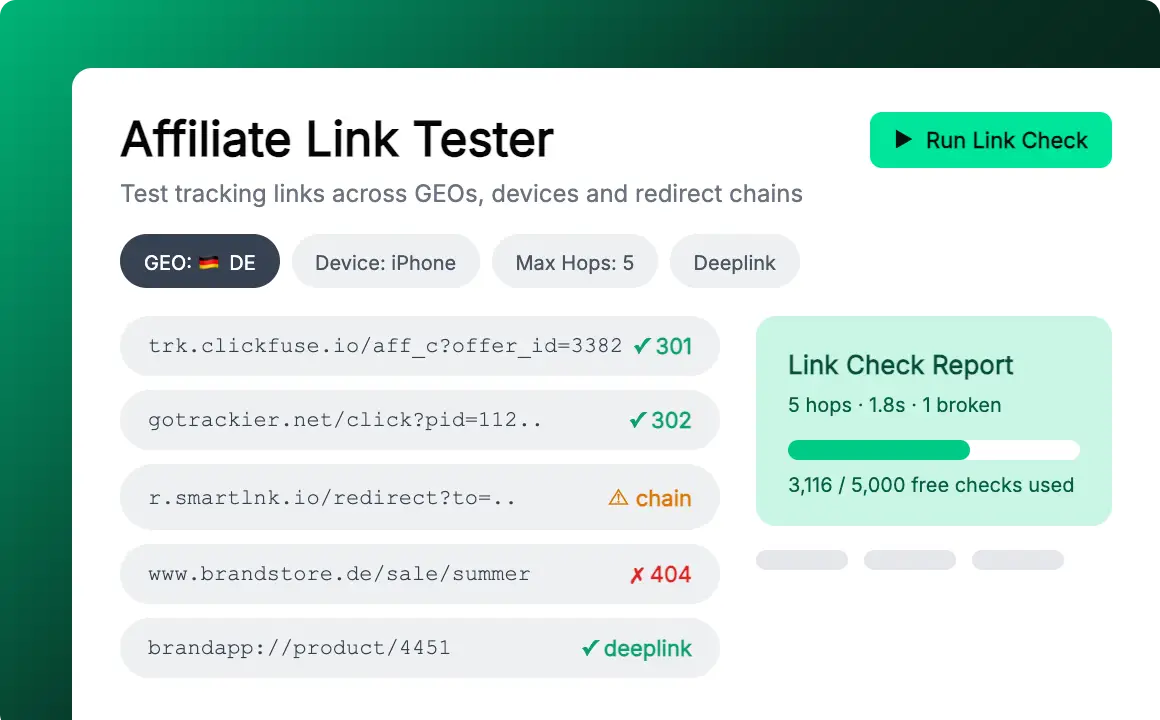
Map every hop from click to conversion. Track 301s, 302s, smartlinks, and multi-network setups across up to 10 redirect levels. Spot rebrokering, unauthorized intermediaries, and latency-killing redirect chains before they drain your ROI.
Global & Device Validation
Simulate clicks from different geographic locations and mobile or desktop devices to verify your links are still active and targeting the right audience.
Landing Page Accuracy
Ensure every click is redirecting to the correct landing page rather than a broken 404 or a generic “offer expired” screen.
Comprehensive Protocol Support
Our system fully supports 301 and 302 redirects, as well as complex smartlinks and shortened links, giving you a transparent view of every “hop” in the journey.
Find Broken Links & Redirect Issues
You launched a campaign. Traffic is flowing. Clicks are coming in. But conversions? Flat.
The problem might not be your creative or your targeting. It could be something far more basic: your affiliate links are broken, redirecting to the wrong page, or failing to open on mobile devices.
Performance marketers lose thousands of dollars every day because of link failures they never knew existed. A redirect chain that adds 3 seconds of load time. A geo-targeting rule that sends German users to the US store. A deep link that dumps iOS users on a web page instead of the app.
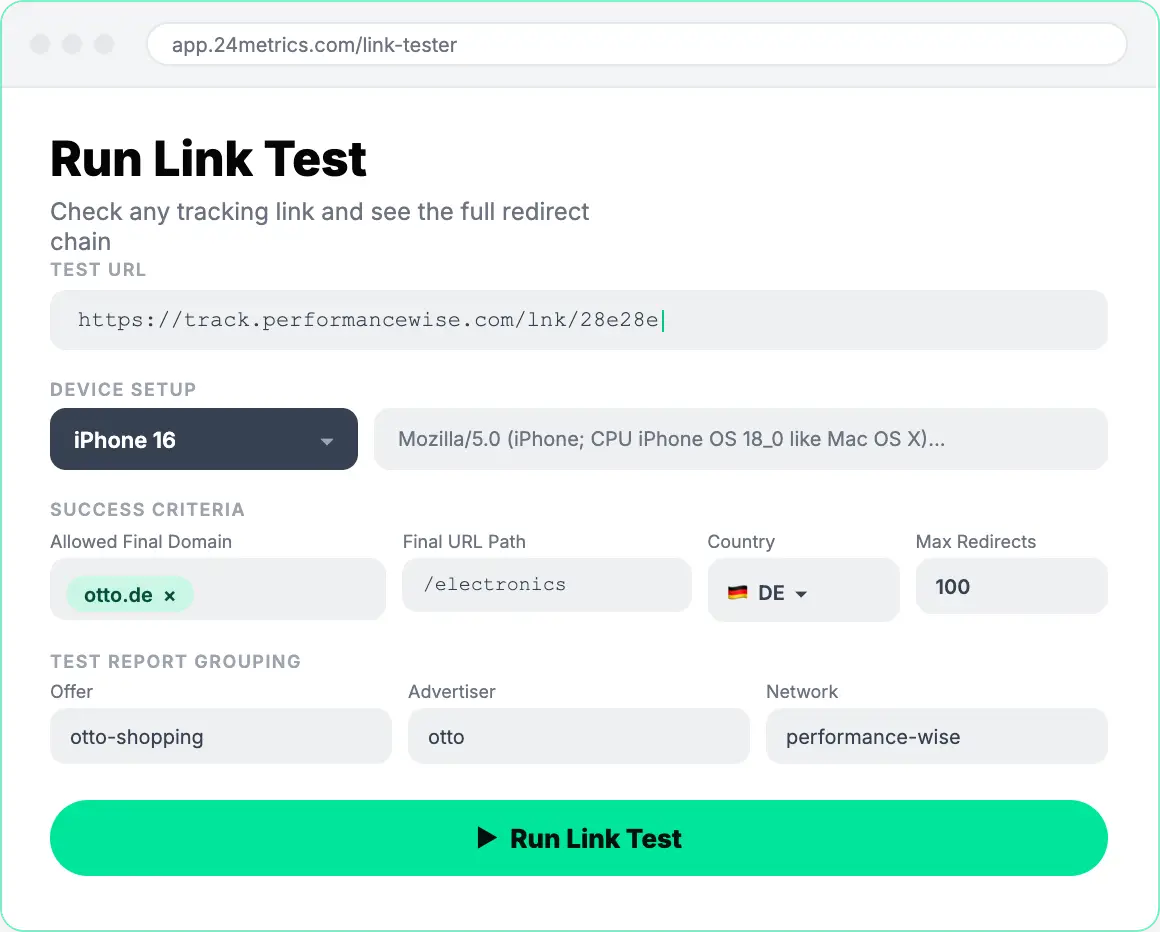
The 24metrics Affiliate Link Checker catches these issues before they drain your budget. Test any URL, see the full redirect path, and fix problems before they impact your ROI.
Why Traditional Affiliate Tracking Isn’t Enough
The affiliate marketing ecosystem has grown increasingly complex, with a single tracking link often passing through multiple redirect servers before reaching its final destination. Each hop introduces potential failure points.
When someone clicks an affiliate link, it first hits your tracking platform, then passes to the advertiser’s system, may route through a fraud detection layer, and finally lands on the destination page. If any step in this chain fails or is delayed, the conversion is at risk.
For networks and advertisers processing millions of clicks daily, even a 1% link failure rate can translate into significant revenue loss. That’s why leading performance marketing teams invest in systematic link validation as part of their fraud prevention and quality assurance workflows.
Common Affiliate Link Problems & How to Detect Them
Broken Links & Dead Destinations
The most obvious failure is a link that simply does not work. The destination page returns a 404 error, the domain has expired, or the product has been discontinued. These broken links create terrible user experiences and waste your advertising spend.
Detection requires actually requesting the final URL and verifying it returns a valid response. Our Link Check API performs this validation at scale, testing thousands of URLs per minute and flagging any that return error codes.
Excessive Redirect Chains
Every redirect in a chain adds latency. Research consistently shows that page load delays directly impact conversion rates. When your affiliate link passes through 5, 7, or even 10 redirects before reaching the landing page, you are bleeding conversions with every hop.
Worse, long redirect chains are a common indicator of rebrokering. This happens when unauthorized parties insert themselves into the redirect path to steal commissions. If you suddenly see your links routing through unfamiliar domains, that is a major red flag.
A proper affiliate link tester counts each redirect and maps the complete chain from initial click to final destination. This visibility lets you identify bloated paths and suspicious intermediaries.
GEO Testing Failures
Global campaigns require links that behave correctly for users in different countries. A link meant for UK traffic should land on the UK site, not default to the US version. Currency mismatches, language errors, and regional product availability issues all stem from geo targeting failures.
Testing geo behavior requires simulating clicks from different locations. Our platform uses residential IPs worldwide to test how links perform from the actual geographic perspective of your target audiences. This catches issues that would be invisible from a single testing location.
Platform Incompatibility
Mobile traffic now dominates affiliate marketing. But mobile introduces unique challenges around deep linking and app detection.
When a user clicks an affiliate link on their phone, what should happen? Ideally, if they have the advertiser’s app installed, the link opens directly in the app to the relevant product page. This is called deep linking, and it dramatically improves conversion rates compared to mobile web experiences.
But deep links break constantly. App updates change URL schemes. Platform policies evolve. What worked last month might dump users on an error page today.
Our affiliate link tester validates deep link behavior across iOS and Android, checking whether links correctly trigger app opens or gracefully fall back to mobile web when the app is not installed.
Wrong Domain Destinations
Sometimes links technically work but send users to the wrong place entirely. A link meant for a specific product page lands on the homepage. A link for Partner A’s offer somehow ends up on Partner B’s site.
These misdirections often indicate configuration errors in tracking platforms. They can also signal more serious issues like unauthorized link manipulation. Either way, catching them requires comparing the actual destination against the expected outcome.
How Our Affiliate Link Tester Works
Geographic Simulation
Test link behavior from any country. Our network of residential IPs lets you verify that German traffic goes to German landing pages, Japanese traffic goes to Japanese stores, and so on. This matters especially for affiliate compliance with advertiser requirements around regional targeting.
Device Emulation
Simulate how links behave on different devices and operating systems. Check whether iOS users get the app deep link experience while Android users might see something different. Identify cases where mobile users get served desktop pages or vice versa.
Deep Link Verification
For mobile app campaigns, test whether deep links actually trigger app opens. Identify links that claim to support deep linking but actually fail when tested from mobile devices. This prevents situations where you are paying for app install campaigns that dump users in web browsers.
Response Validation
Beyond just checking that a link works, we verify the quality of the response. Does the landing page return proper HTTP 200 status? Is the content what you expected? Are there any warning signs like redirect loops or timeout errors?
Redirect Analysis
Every redirect in the chain gets logged with its HTTP status code, response time, and destination URL. You can see exactly how your link routes from first click to final landing page. The system flags chains that exceed reasonable redirect counts or include unexpected domains.
Use Cases for Systematic Link Testing
Pre-Launch Validation
Before any campaign goes live, run all tracking links through validation. Catch problems when fixing them costs nothing, not after you have spent budget driving traffic to broken destinations.
Continuous Monitoring
Links can break at any time. A partner might change their redirect configuration. An advertiser might update their landing page URLs. Set up regular automated testing to catch issues as they emerge rather than discovering them in your monthly performance review.
Partner Compliance Checking
Verify that your affiliate partners are routing traffic correctly. If you have specific requirements about redirect chains, destination pages, or geographic targeting, automated testing lets you enforce those rules at scale. For more on maintaining partner quality, explore our affiliate fraud prevention resources.
Fraud Investigation
When conversion rates drop unexpectedly, link testing helps diagnose the cause. Are links actually reaching the right destinations? Has someone inserted unauthorized redirects? Is there rebrokering happening in your tracking chain? Link validation works alongside other fraud detection tools to provide complete visibility into campaign health.
API Integration for Automated Testing
The Link Check API integrates directly into your existing workflows. Connect it to your tracking platform to automatically validate new links as they are created. Wire it into your monitoring systems to alert when link health degrades.
The API returns structured data including complete redirect chains with timing for each hop, final destination URLs, HTTP status codes at each step, geographic behavior differences, and device specific behavior variations.
This data feeds into dashboards, alerting systems, and compliance reporting. Teams using our API typically integrate it into their campaign launch checklists and continuous monitoring pipelines.

Getting Started With Affiliate Link Testing
Audit Your Campaigns
First, audit your highest volume campaigns. Run your top 100 links through testing to establish a baseline. You will likely find issues you did not know existed.
Pre-launch Validation Test
Second, implement pre-launch validation. Make link testing a required step before any campaign activation. This single change prevents most link-related issues from ever reaching live traffic.
Automate Regular Tests
Third, set up ongoing monitoring. Schedule regular automated tests of active campaign links. Weekly testing catches most issues before they significantly impact performance.
Integrate Fraud Prevention
Fourth, integrate with your fraud prevention workflow. Link testing data provides valuable signals for identifying suspicious activity. When combined with click fraud detection and conversion analysis, it creates comprehensive campaign protection.
The Cost of Not Testing
Every broken link represents lost revenue. Every excessive redirect bleeds conversions. Every deep link failure frustrates users who were ready to buy. Performance marketers obsess over creative testing, audience optimization, and bid strategies. These matter. But none of it matters if your links do not work properly.
Affiliate link testing is foundational infrastructure. It is the plumbing that makes everything else possible. And with API-based solutions that can validate thousands of links per minute, there is no reason to operate without it.
The API returns structured data including complete redirect chains with timing for each hop, final destination URLs, HTTP status codes at each step, geographic behavior differences, and device specific behavior variations.
This data feeds into dashboards, alerting systems, and compliance reporting. Teams using our API typically integrate it into their campaign launch checklists and continuous monitoring pipelines.
