
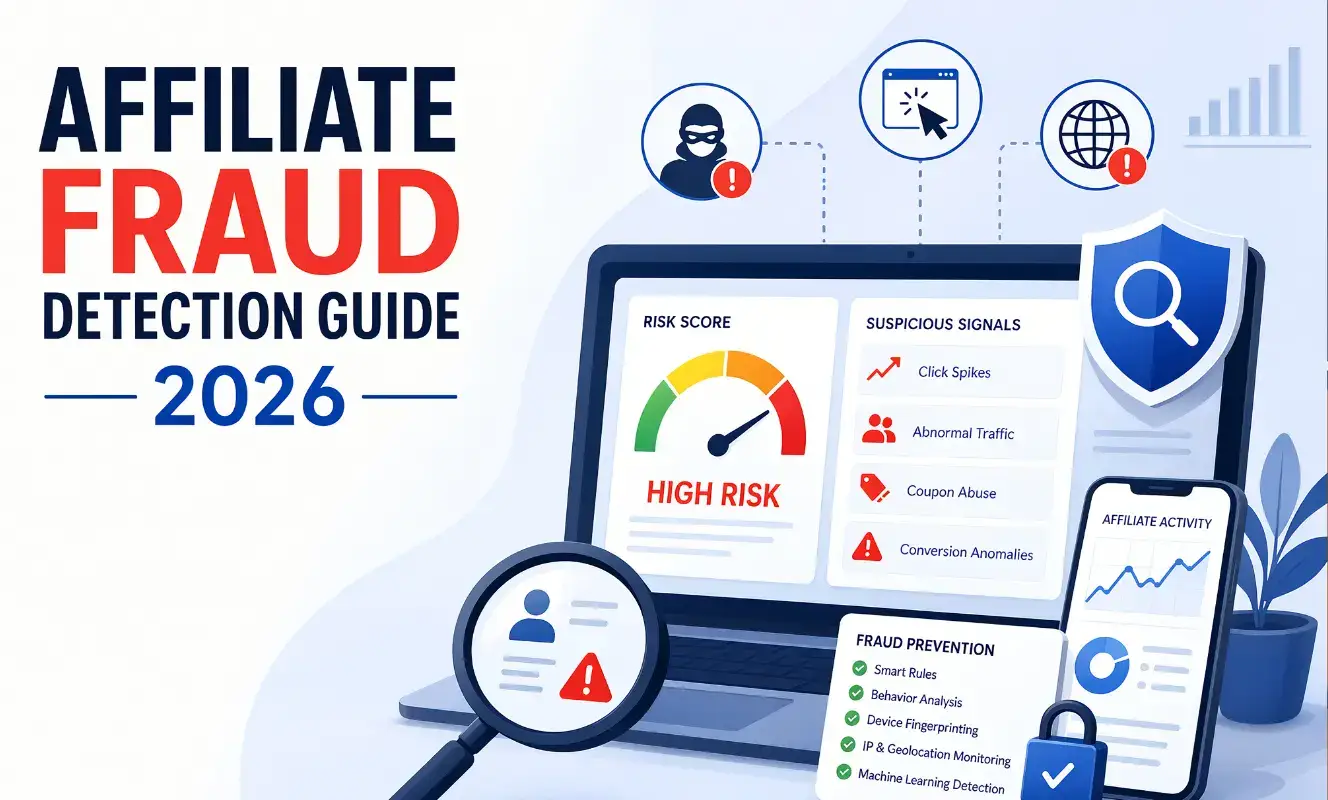
You approve a new partner. The clicks come in fast. Conversions look healthy for a week. Then your finance team asks why the channel’s cost per acquisition jumped 30 percent while your real customer count barely moved. That gap is almost always affiliate fraud, and most teams only spot it after they have already paid for it.
Affiliate fraud is the quietest line item in performance marketing. It rarely arrives as one big event. It leaks out of your budget click by click and lead by lead while your dashboards still look fine. For programs running with no active screening, industry estimates put the waste at 15 to 25 percent of spend.
This guide breaks down what affiliate fraud is, the main types you will actually run into, the warning signs sitting in your own data right now, and how detection works when you want to stop paying for traffic that was never real.
What is affiliate fraud?
Affiliate fraud is any attempt to earn commissions from an affiliate or partner program using traffic, leads, or sales that aren’t real. A fraudster manufactures the exact activity your program pays for, whether that is clicks, signups, installs, or attributed sales, then collects the payout before anyone verifies that a genuine customer was involved.
It shows up under a few names. You will hear it called affiliate marketing fraud, partner fraud, or affiliate program fraud. The label changes, the mechanics don’t. Someone is gaming the rules that decide who gets paid.
The reason it works is simple. Your program is built to reward performance, and a payout sitting on the other side of a click or a form fill is a target. When the reward is automatic and the verification is loose, fraudsters move in.
Why affiliate fraud keeps getting worse
The money involved is hard to ignore. Research firm Juniper Research found that digital advertisers lost roughly $84 billion to ad fraud in 2023, about 22 percent of all online ad spend, and projects that figure to climb toward $172 billion by 2028. (Juniper Research) Mobile takes the worst of it, with close to 30 percent of mobile ad spend lost to fraud.
Three things are pushing those numbers up. Affiliate budgets are growing, which means bigger pools of commission to steal. Bot tooling has gotten cheap and convincing, so manufacturing fake traffic costs almost nothing. And generative AI now lets fraudsters mimic human click patterns, rotate identities, and pass shallow checks that used to catch them.
The result is that the old approach, reviewing your affiliate report at the end of the month and clawing back what looks suspicious, no longer keeps up. By the time you spot the pattern, the commission is usually already out the door.
The main types of affiliate fraud
Fraud leaves footprints. Knowing the common tactics tells you where to look. These are the types that cost real money across lead generation, mobile, and ecommerce programs.
Click fraud and click spam
Fraudsters use bots or click farms to fire large volumes of fake clicks against your offers, either to earn per-click payouts or to bury a real install or sale under their own attribution. You see the symptom as huge click counts with almost no conversions, or sudden traffic spikes at strange hours. This is the same engine behind paid search abuse, which is why click fraud and brand bidding tend to show up together in programs that run both channels.
Cookie stuffing and attribution theft
Here the fraudster drops affiliate cookies onto a user’s browser without any real click or recommendation, often through hidden iframes or pop-unders. When that user later buys on their own, the fraudster’s cookie claims the commission. The giveaway is conversions with almost no visible referral traffic, or credit going to a partner who produced nothing a customer would have seen.
Lead fraud and fake signups
For cost-per-lead and cost-per-acquisition programs, the product being faked is the lead itself. Bots and scripts submit forms with stolen, recycled, or completely invented contact data, sometimes the same person registered hundreds of times from one device. Your CRM fills with garbage, your sales team wastes hours, and you pay for every fake record. Disposable email domains and duplicate device fingerprints are the usual tells.
Mobile app install fraud
Mobile user acquisition has its own family of fraud. Click injection steals attribution by firing a click in the split second before a real install completes. Click spamming blasts clicks so that any organic install in the window gets falsely attributed. SDK spoofing fakes installs and in-app events on the server side without a real device involved at all. Install farms add raw volume on top. The damage is doubled here, because you pay for the install and you also corrupt the data your team uses to optimize.
Domain hijacking, typosquatting, and brand bidding
Some affiliates buy domains that look like yours (typosquatting), trigger a click, then instantly redirect the user to your real site to grab credit for a visit they never earned. Others bid on your brand keywords against your program terms, inflating your own paid search costs to take a cut. Extremely short time-on-site and redirect chains in your tracking parameters point to this. It is also worth checking that your links land where they should, since hijacked or broken links bleed revenue quietly. You can test your affiliate links across regions and devices to catch this.
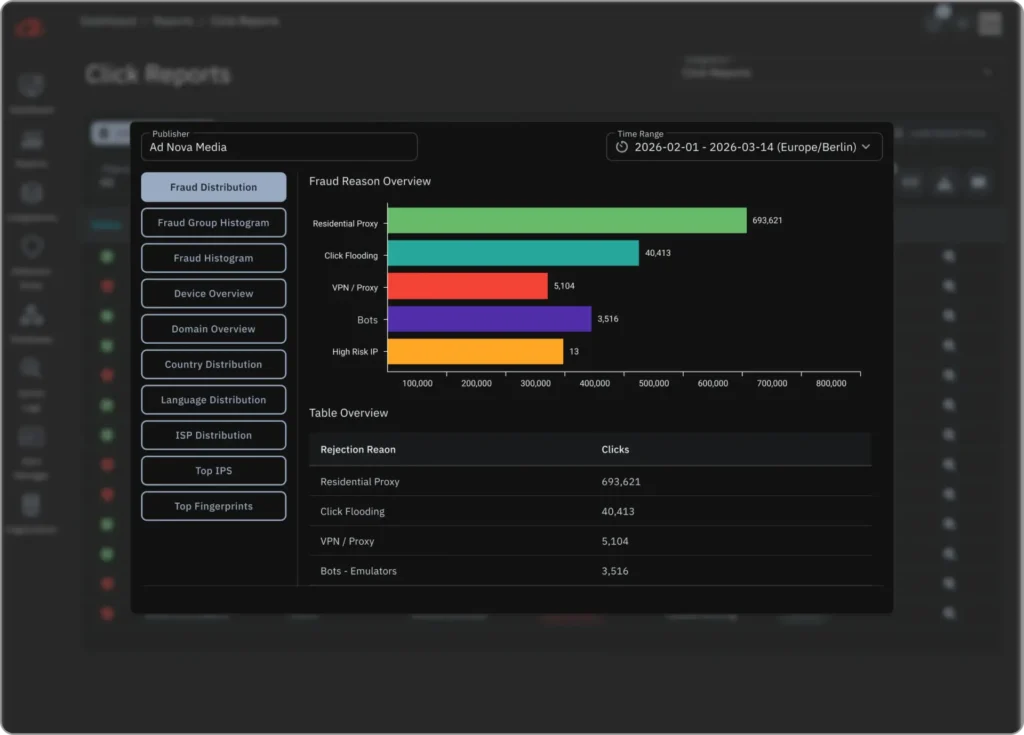
Bot and proxy traffic
Underneath most of the tactics above sits the same raw material: traffic that is not a person. That includes data-center bots, residential proxy networks that disguise where traffic actually comes from, and VPN-masked sessions designed to dodge geo rules. On the impression side, the equivalent is impression fraud, where ad views are manufactured to drain budget with no human ever seeing the creative.
Warning signs in your own data
You do not need a tool to start looking. These signals are visible in most affiliate reports, and any one of them is worth a closer look:
- High clicks, near-zero conversions from a single partner or source. The most common opening symptom of bot traffic.
- Conversion spikes from brand-new partners. Real partners ramp gradually. A first-week partner outperforming your best long-term affiliate is a flag, not a win.
- Clusters from one IP, device, or fingerprint that show up as many “different” users. Fraud at scale reuses infrastructure.
- Traffic at odd hours or from countries you don’t target, including impossible jumps between locations for the same user.
- Ultra-short session durations and high bounce rates. Real users browse. Bots arrive and convert in seconds.
- Lead data from disposable email services, or a mismatch between billing location and IP location.
- A surge in chargebacks tied to a specific affiliate, which often signals stolen payment data.
None of these is proof on its own. Together, and especially when they cluster around one partner, they tell you exactly where to dig.
How affiliate fraud detection actually works
The single biggest mistake is treating fraud detection as a monthly cleanup. If you only catch fraud after the conversion lands, you have usually already paid the commission and polluted your reporting. The fix is to screen traffic in real time, before it counts.
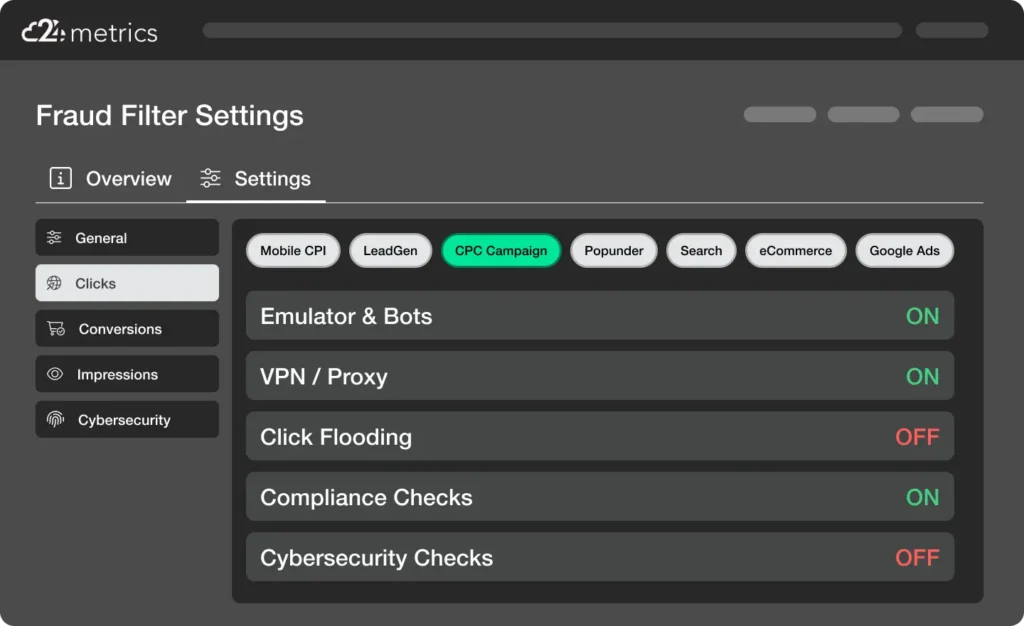
Effective real-time affiliate fraud detection layers several checks on every click, lead, install, and impression:
- IP and network intelligence to flag data centers, known proxy networks, and VPN exits.
- Device fingerprinting to spot the same device pretending to be many users, and to catch emulators favored by bot operators.
- Behavioral analysis that compares session patterns against what a genuine user looks like for your offer.
- Rule-based scoring where each signal raises or lowers a risk score, so you can set the threshold that fits your program.
- Lead and conversion validation that checks the quality of the data itself, not just the click that delivered it.
24metrics runs these checks at the click level in real time and lets you decide what happens next: block the traffic outright or just monitor it while you investigate. Every rejection comes with a clear, reproducible reason that you can pass back to the publisher through postbacks, so disputes stay factual instead of turning into a fight. Customers typically see a 10 to 30 percent drop in media cost once they stop paying for fraudulent clicks and conversions.
One caution. Aggressive filtering that blocks legitimate traffic damages partner relationships faster than fraud does. The goal is a low false-positive rate, not the highest possible block count. Good detection is precise, not just strict.
Affiliate fraud looks different in each vertical
The tactics shift depending on what you are paying for, so your screening should too.
Lead generation gets hit with fake and duplicate leads, disposable emails, and co-registration abuse. Validate leads as they come in, before they reach your CRM or your buyers.
Mobile user acquisition faces click injection, click spamming, SDK spoofing, and install farms. The key is screening before the install is attributed, so fraud never reaches your source of truth in the first place.
Ecommerce deals with cookie stuffing, coupon and browser-extension hijacking, stolen-card orders, and serial returners. Screening at checkout and on attribution protects both your margin and your data.
Stop paying for traffic that was never real
Affiliate fraud is not going away, and no single filter solves it forever. The programs that stay clean are not the ones that run an audit once a quarter. They screen every click, lead, and install the moment it arrives and pay only for activity they can actually verify.
If you want to see how much of your current affiliate traffic would get flagged, 24metrics screens clicks, conversions, installs, and impressions in real time and shows you exactly why each one was rejected. Read here how our solution compares to competitors like Anura, SEON, or IPQS. Start a free trial or book a demo and run your own traffic through it.

